
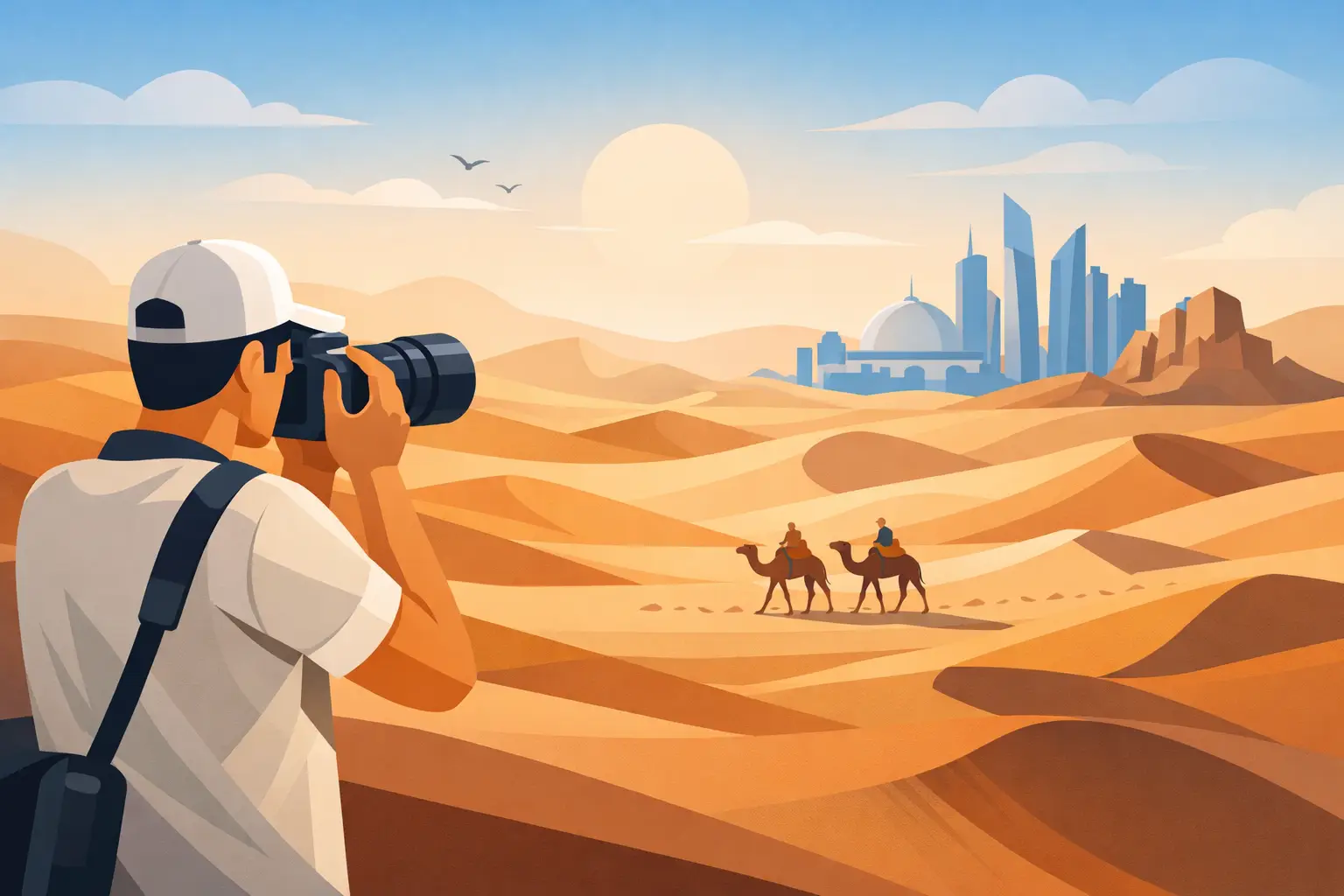
The desert changes character by the minute. At sunrise, Abu Dhabi’s dunes glow peach and gold; by late afternoon, long shadows carve dramatic lines into the sand; after sunset, the horizon softens into a deep blue silence. Learning how to photograph desert landscapes is less about chasing one perfect camera setting and more about being ready for these brief, breathtaking changes in light.
For travelers, that is part of the magic. A desert safari can bring you beyond the city skyline and into wide-open scenes where every dune, camel track, and wind-shaped ridge feels cinematic. With a little preparation, even a first-time photographer can return with images that feel as memorable as the adventure itself.
Choose the light, not just the location
The Arabian desert is spectacular at any hour, but midday is usually the hardest time to photograph. The sun sits high, the sand can look pale and flat, and strong contrast makes it difficult to hold detail in both bright dunes and dark shadows. If your schedule allows, plan your photography around sunrise or the final two hours before sunset.
Sunrise is ideal for calm, clean images. The sand is often undisturbed, temperatures are more comfortable, and the low sun reveals delicate ripples across the dunes. It is a wonderful fit for travelers who want quiet landscapes, soft color, and a peaceful start to a desert experience.
Late afternoon and sunset bring more drama. The setting sun creates long, graphic shadows, turning simple dune slopes into bold shapes. This is also when you may be able to include a camel ride, a 4×4 vehicle on a distant ridge, or a traveler walking along a crest for a sense of scale. An evening safari offers this golden-hour opportunity alongside the energy of dune bashing and the warmth of a Bedouin-style camp.
Stay for the blue hour if you can. The few minutes after the sun disappears can produce rich violet and navy tones above the warm desert floor. A tripod helps, but a steady hand and a camera with good low-light performance can still capture the mood.
How to photograph desert landscapes with stronger composition
Desert scenes look simple from a distance, which makes composition especially important. A broad frame of sand and sky can be beautiful, but it needs a focal point or a deliberate shape to hold the viewer’s attention.
Start by looking for leading lines. Dune ridges, tire tracks, camel tracks, and the curved edge where light meets shadow can lead the eye through the photograph. Instead of placing the horizon in the middle by habit, try moving it higher to emphasize dune textures or lower to give a colorful sunrise or sunset room to breathe.
Look for layers as well. One dune in the foreground, another in the middle distance, and a hazy ridge beyond it create depth. If the desert appears flat in your photo, move a few steps sideways or change your height. A small change in position can separate the dunes and reveal more dimension.
Including a person is one of the easiest ways to show the true scale of the landscape. Ask your travel companion to stand still on a ridge, walk slowly along a dune line, or pause beside a camel. Keep the person small within the frame so the desert remains the hero. Bright clothing can add a striking point of color against the gold sand, while white or neutral clothing creates a quieter, more natural look.
For a more intimate image, turn away from the big view. Photograph the repeating ripples at your feet, a single desert plant, the curve of a footprint, or windblown sand moving across a ridge. These details tell the story of the desert just as powerfully as a wide panorama.
Use simple camera settings that protect the highlights
Desert light is bright, and sand reflects more light than many visitors expect. The most common mistake is an overexposed image where the brightest dunes lose their texture. Check your screen and histogram when possible, and slightly reduce exposure if the sand looks washed out.
For wide desert views, use a low ISO, usually ISO 100 or 200, and an aperture around f/8 to f/11. This gives you strong image quality and keeps much of the scene sharp. Choose your shutter speed based on the available light, using a tripod if it becomes too slow for handheld shooting.
If you are photographing dune bashing, camel rides, or sandboarding, prioritize shutter speed. A setting around 1/1000 second can freeze flying sand and fast movement in bright conditions. For a creative sense of motion, try a slower shutter speed as a vehicle passes, but take this only from a safe, approved position.
A phone camera can create excellent desert images, especially in good light. Tap on the brightest part of the scene and lower the exposure slider slightly before taking the shot. Use the phone’s wide lens for sweeping views, then switch to the standard lens for more natural-looking dunes and portraits. Avoid excessive filters. The real colors of a UAE sunset are already extraordinary.
Pack for sand, heat, and changing conditions
Sand is part of the experience, but it can be difficult on camera gear. Keep your camera in a zippered bag during transport, particularly while riding in a 4×4 over the dunes. Change lenses only when necessary and preferably inside a vehicle or sheltered camp area. A soft brush, microfiber cloth, and a protective camera cover are useful additions to your day bag.
Bring more water than you think you need, wear sunglasses, and use sunscreen even on cooler winter days. A hat with a secure strap is practical when the wind picks up. Closed shoes make walking on hot sand and climbing dunes easier, although you may still enjoy taking them off for a few frames of bare footprints in the sand.
A tripod is worthwhile for sunrise, blue hour, and night photography, but it is not essential for every visitor. If you are traveling light, focus on timing and composition rather than carrying too much equipment. One camera or phone, one versatile lens, and a fully charged battery can be enough for an unforgettable set of photos.
Make the most of a guided desert experience
The best desert images often come when you are not worrying about navigation, parking, or whether you have reached a permitted area. A guided experience gives you access to dramatic dunes while leaving time to watch the light and enjoy the moment. Let your guide know that photography is a priority, especially if you hope to capture sunrise, sunset, camel trekking, or an overnight sky.
Abu Dhabi Desert Safari can be a convenient choice for travelers who want transportation, desert adventure, and cultural experiences organized in one memorable outing. A sunrise tour favors peaceful landscapes and soft light, while an evening or overnight safari offers sunset scenes, camp details, performances, and the possibility of photographing a starlit sky.
During active moments, keep your gear secured and follow your guide’s safety instructions. Do not step into a vehicle route for a photo, climb unstable dune edges, or separate from the group in low light. The desert is vast, and the safest photograph is always the one taken with awareness.
Photograph the desert after dark
An overnight desert stay opens a completely different chapter of photography. Away from city lights, the sky can reveal far more stars than visitors expect. Start just after sunset, when there is still a trace of color on the horizon and enough detail in the dunes to anchor the frame.
For stars, use a wide lens, a sturdy tripod, and manual focus. Focus on a distant bright object before the sky becomes fully dark, then avoid touching the focus ring. A starting point for many cameras is a wide aperture, ISO 1600 to 3200, and an exposure of roughly 10 to 20 seconds. Review the image closely, because settings depend on your lens, the moon, and the amount of ambient light at camp.
Respect fellow guests while shooting at night. Keep lights low, avoid shining a flashlight toward tents or performers, and ask permission before photographing people around the campfire. Those small courtesies protect the relaxed, welcoming atmosphere that makes an overnight desert experience special.
The finest desert photograph may not be the most technically perfect one. It may be the frame where a camel crosses a sunlit ridge, where your family’s footprints disappear behind you, or where the last glow of sunset rests on the dunes. Slow down, watch the light, and give yourself time to make a memory before you make the picture.

